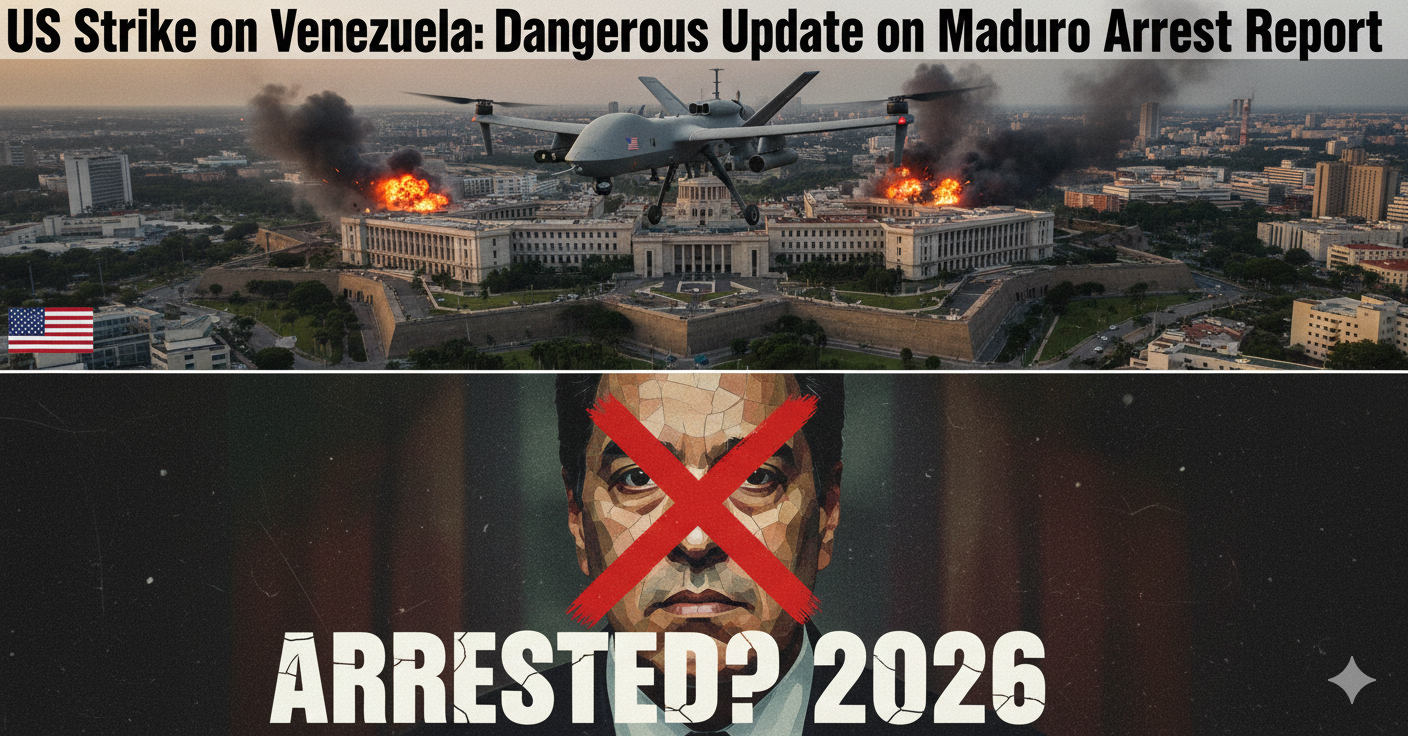
US Strike On Venezuela With “Black Swan” January 2026 Shock Military Operation And Maduro Capture False Flag Move
Introduction — What Just Happened
The US (US Strike on Venezuela) initiated full-scale military strikes against Venezuela, with assaults all over the country, including Caracas on January 3,2026. U.S. authorities reported that President Nicolás Maduro and his wife were captured and flown out of the country following the operation. President Donald Trump announced that the U.S. would temporarily “run” Venezuela to oversee a transition of power.
This explainer unpacks the background, difference between what has been claimed versus confirmed or denyed, strategic setting historic context, international response and what it tells for those seeking to learn global politics economy and current affairs.
The Background — Why the Explosion Happened

Historical Tension US Strike on Venezuela
- The seeds of this radical development reach back months and are connected to the political tensions that have escalated between the U.S. and the Maduro regime.
- The United States and Venezuela have had adversarial relations for years now, at odds principally over democracy, human rights and allegations of corruption.
- From 2020-2025, Maduro faced indictment in the U.S. for narco-terrorism and drug trafficking.
- Sanctions on Venezuela’s oil industry were regarded by the U.S. as a linchpin in its efforts to take down Maduro’s government.
Campaign of Pressure
- Prior to these strikes, U.S. forces were involved in:
- Air and naval operations to intercept drug-smuggling convoys.
- More military in the Caribbean.
- Political pressure via sanctions and public rhetoric.
That long prelude and crony briefing help set the stage for what is now mysteriously termed Operation Absolute Resolve — the formal U.S. military plan that resulted in action at first light on January 3.
Key Highlights
1. Operation Absolute Resolve

What the U.S. Says Happened
- The U.S. executed coordinated airstrikes and a special operations raid.
- Over 150 aircraft and forces including Army, Air Force, Navy, Marine Corps, and possibly Delta Force were involved.
- Maduro and his wife were reportedly detained and flown out of Venezuela.
Verified Facts vs Claims
| Claim | Verified / Unverified |
|---|---|
| Maduro captured | Reported by U.S. officials |
| Maduro flown to U.S. | Reported by multiple outlets |
| Details of custody location | Not independently verified |
| Delcy Rodríguez interim president | Constitutionally possible but disputed in practice |
| U.S. will run Venezuela (US Strike on Venezuela) | Statement by Trump |
| Legality under international law | Contested |
2. Who’s in Charge in Venezuela Now
- Venezuelan Vice President Delcy Rodríguez claims she is the interim president under Venezuela’s constitution.
- The U.S. government says it will oversee Venezuela’s affairs until a transition is possible.
- US Strike on Venezuela
There is a power struggle and confusion about legitimate leadership inside the country.
3. The Legal and Political Complexity
- Maduro faces U.S. narco-terrorism charges from earlier indictments, now set to be reinforced with his alleged custody.
- Many international leaders condemn the U.S. action as a violation of sovereignty and international law.
Countries like Brazil, South Africa, and China criticized the strikes as illegal.US Strike on Venezuela Some European governments were less vocal or ambiguous.
Global Political Impact
Region
- Latin American governments have been sharply divided:
- Some call the attack illegal and destabilizing.
- US Strike on Venezuela
- Others, allied to the U.S., express support or tacit acceptance.
International Law
- The United Nations Security Council plans to examine the legality of the strikes.
- Critics argue the action sets a dangerous precedent for foreign intervention.
Economic Consequences
Oil Markets
- Venezuela holds massive oil reserves.
- Trump’s statements indicate U.S. intention to involve American oil firms in rebuilding or managing Venezuelan oil infrastructure.
Trade and Sanctions
- New layers of sanctions and tariff changes could emerge.
- Regional trade patterns may shift as nations reassess relationships with the U.S. and Venezuela.
Why This Is Important For Aspirants (Geography,Polity&Economics)
This topic is highly important if you are appearing for UPSC, SSC, MTS and other competitive Government exams.
Geography
- Resource geography: Venezuela has some of the world’s largest oil reserves.
- Space markets are directly correlated with geopolitical interventions.
Polity
- State Sovereignty vs Intervention: This is the last straw; state sovereignty v intervention – principles of equality among nations enshrined in the UN Charter.
- Constitutional Succession: Delcy Rodríguez’s assertion is based on Article 233 of Venezuela’s constitution.
Economics
- Oil production and pricing may be influenced by foreign involvement and sanctions.
- Geopolitical instability often leads to market volatility and affects global energy security.
Expert Perspectives
Policy analysts warn that the U.S. action, regardless of intent, could reshape norms of international military intervention.
Some analysts see parallels to historical U.S. interventions in Latin America, while others argue the unique charge of narco-terrorism opens a different legal frame.
Conclusion
This event marks a dramatic flashpoint in U.S.–Venezuela relations with consequences rippling across global diplomacy, regional stability, and economic markets.
Key takeaways:
- The U.S. claims control and custody of Maduro, but details remain under verification.
- International law experts and foreign governments are debating legality.
- The situation is fluid; leadership and governance inside Venezuela remain contested.
For aspirants, this episode is a live case study in geopolitics, constitutional succession, and international law, and deserves close attention in current affairs preparation.


