

UPSC Syllabus 2026 Complete Guide – Full Prelims & Mains Latest Syllabus Explained
When I first started my UPSC journey, I remember staring at the UPSC Syllabus 2026 PDF for hours without understanding how big the exam was. I had heard senior aspirants say “prelims is just the beginning” — and only later did I truly grasp how important it is to know the syllabus deeply, stage by stage. In this guide, I walk you through UPSC Syllabus 2026 clearly and practically — just as I would explain it to a fellow aspirant who’s serious about clearing this exam.
All the syllabus details below are based on the official Union Public Service Commission (UPSC) scheme and examination details as given on the official site. (UPSC)
Table of Contents
- Overview: What is UPSC and Why Syllabus Matters
- UPSC Exam Stages — Quick Snapshot (Prelims, Mains & Interview)
- UPSC Prelims Syllabus 2026 — Detailed Breakdown
- UPSC Mains Syllabus 2026 — Paper-by-Paper Guide
- Optional Subjects & Tips
- Example Study Approach
- Infographics & Tables
- Frequently Asked Questions
1. Overview: What is UPSC and Why Syllabus Matters
The Union Public Service Commission (UPSC) conducts the Civil Services Examination (CSE) every year to recruit officers for Indian administrative services like IAS, IPS, IFS, IRS, etc. The exam is known for its vast syllabus, rigorous selection stages, and high level of competition.
Understanding the UPSC Syllabus 2026 is the foundation of your entire preparation strategy. When I first ignored syllabus structure, I ended up wasting months just reading books aimlessly. Only after mapping topics to the syllabus did my preparation become focused and consistent.
You can check the official UPSC syllabus and exam scheme here: UPSC Revised Syllabus and Scheme (official link). (UPSC)
2. UPSC Exam Stages — Quick Snapshot
The UPSC CSE has three key stages:
| Stage | Purpose | Marks Counted | Mode |
|---|---|---|---|
| Prelims | Screening test | Marks not counted for final rank (only qualifying) | Objective MCQs |
| Mains | Merit determination | Descriptive papers | Written |
| Interview / Personality Test | Final ranking | 275 marks | Personal interaction |
The entire UPSC Syllabus 2026 revolves around these stages. To even reach the Mains, you must qualify the Prelims. Preparing without syllabus clarity is like sailing without a compass — you might move, but never reach the correct destination.
3. UPSC Prelims Syllabus 2026 — Detailed Breakdown
What is in Prelims?
Prelims consists of two papers, both held on the same day — one in the morning, the other in the afternoon. (UPSCprep.com)
Prelims Paper I — General Studies (GS-1)
- Marks: 200
- Duration: 2 Hours
- Type: Objective (MCQ)
- Purpose: Merit determining
Topics:
- Current events (national & international)
- History of India & Indian National Movement
- Indian and World Geography (physical, social, economic)
- Indian Polity & Governance & Constitution
- Economic and Social Development
- Environmental Ecology, Biodiversity & Climate Change
- General Science (UPSCprep.com)
💡 Example: Questions may ask about the causes of economic recession, climate change effects, or landmark Supreme Court judgments tied to governance. These topics are directly from the UPSC Syllabus 2026 Prelims. (UPSCprep.com)
Prelims Paper II — CSAT (Civil Services Aptitude Test)
- Marks: 200
- Qualifying Only (33% needed)
- Duration: 2 Hours
- Topics:
- Comprehension
- Logical reasoning & analytical ability
- Decision making & problem solving
- Basic numeracy (Class X level)
- Data interpretation (charts, graphs, tables) (UPSC AI)
Tip: CSAT is qualifying. You must score 33% to proceed, but only GS Paper I marks decide Prelims success.
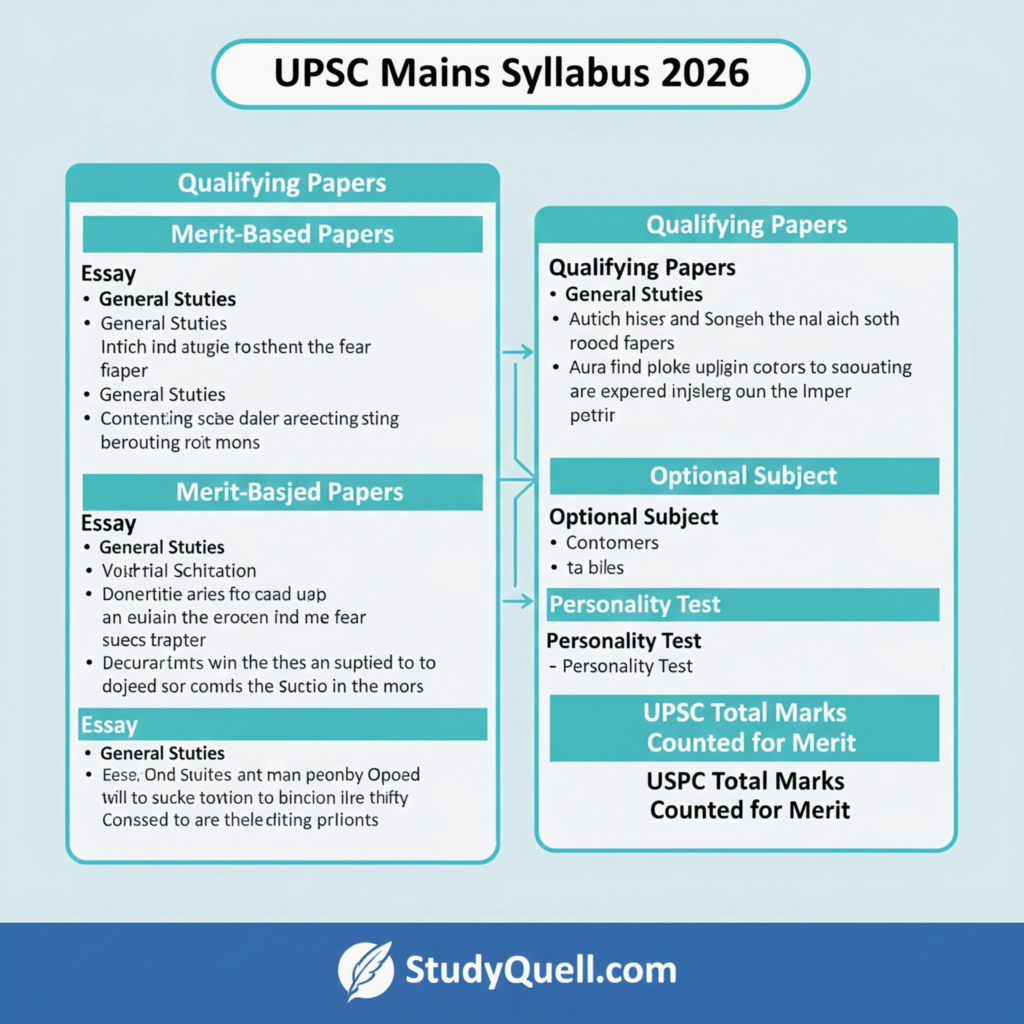
4. UPSC Mains Syllabus 2026 — Paper-by-Paper Guide
Once you clear Prelims, the real game begins — UPSC Mains. It is descriptive and tests your depth of knowledge, writing skills, and analytical ability. (Insights IAS)
🌟 Mains Structure
The Mains consists of 9 papers:
| Paper | Description | Marks |
|---|---|---|
| Paper A | Indian Language (Qualifying) | 300 |
| Paper B | English (Qualifying) | 300 |
| Paper I | Essay | 250 |
| Paper II | GS I — History, Culture, Geography | 250 |
| Paper III | GS II — Polity, Governance & IR | 250 |
| Paper IV | GS III — Economy, Tech, Environment | 250 |
| Paper V | GS IV — Ethics & Aptitude | 250 |
| Paper VI | Optional I | 250 |
| Paper VII | Optional II | 250 |
Total marks for merit: 1750
Interview (Personality Test): 275
Grand Total: 2025 marks (Insights IAS)
Paper I — Essay
This paper tests:
- Clarity of thinking
- Expression skills
- Issue analysis
Students often miss practice here, but essay writing can boost your Mains score significantly if done consistently.
Paper II — General Studies I
Topics include:
- Indian Heritage & Culture
- History (Modern and Pre-modern)
- Geography of India & the World (Indis Academy)
Example: Explain the impact of the Industrial Revolution on global society — typical of GS-I style questions.
Paper III — General Studies II
Focuses on:
- Governance & Constitution
- Polity
- Social Justice
- International Relations (Indis Academy)
Recent exam trends showed more questions on transparency in governance and human rights.
Paper IV — General Studies III
This is a big paper that covers:
- Economy & Economic Development
- Technology & innovation
- Biodiversity & Environment
- Security & Disaster Management (anantaias.in)
Paper V — General Studies IV
Focuses on:
- Ethics
- Integrity
- Aptitude
- Case studies related to moral dilemmas
Ethics plays a crucial role in administrative services.
Papers VI & VII — Optional Subjects
Aspirants choose one from a list of subjects (like Sociology, Public Administration, History, etc.).
Your score in Optional can make or break your rank in UPSC. (Insights IAS)
5. Optional Subjects & Tips
Choosing an optional subject should depend on:
- Your academic background
- Interest level
- Availability of coaching resources
Example: If you have a background in Political Science, it may help you in GS II and your Optional paper too.
6. Example Study Approach
To cover the UPSC Syllabus 2026 effectively, I once divided my study schedule like this:
| Month | Focus |
|---|---|
| Months 1–3 | NCERT + Static Portion |
| Months 4–6 | Current Affairs + Practice |
| Months 7–8 | Mains Answer Writing |
| Months 9–10 | Revision & Mock Tests |
| Final Weeks | Strict Revision Only |
Starting early and updating notes weekly helped me avoid last-minute panic.
7. Infographics & Tables
Prelims vs Mains — Quick Comparison
| Aspect | Prelims | Mains |
|---|---|---|
| Mode | MCQ | Descriptive |
| Qualifying | CSAT | Language Papers |
| Merit | GS Paper I | 7 Papers + Interview |
| Focus | Basic concepts | In-depth analysis |
| Marks Counted | Only GS I | All Papers for Rank |
8. Frequently Asked Questions (FAQ)
Q1. What is included in UPSC Syllabus 2026 Prelims?
UPSC Prelims includes GS Paper I and CSAT Paper II — covering current affairs, history, polity, geography, environment, and aptitude. (UPSCprep.com)
Q2. How many papers are in UPSC Mains?
Mains has 9 papers — 2 qualifying and 7 counted for merit — covering essay, GS I to IV, and optional papers. (Insights IAS)
Q3. Do marks from the interview add to the final rank?
Yes. Interview marks (275) are added to your written total (1750) to calculate final rank. (Insights IAS)
Q4. Is CSAT qualifying?
Yes, CSAT is qualifying with a minimum requirement of 33% marks. (UPSC AI)
Q5. Where can I find the official UPSC Syllabus 2026 PDF?
You can download it from the official UPSC website:
🔗 https://upsc.gov.in/examinations/revised-syllabus-scheme (UPSC)
Thank you for your sharing. I am worried that I lack creative ideas. It is your article that makes me full of hope. Thank you. But, I have a question, can you help me?
Your point of view caught my eye and was very interesting. Thanks. I have a question for you.