

GSEB Board Paper Checking Rules 2026: Examiner Marks Kaise Dete Hain?
GSEB board new general option pattern explained. Learn how examiners check papers & tips to score better marks. Real student experience.
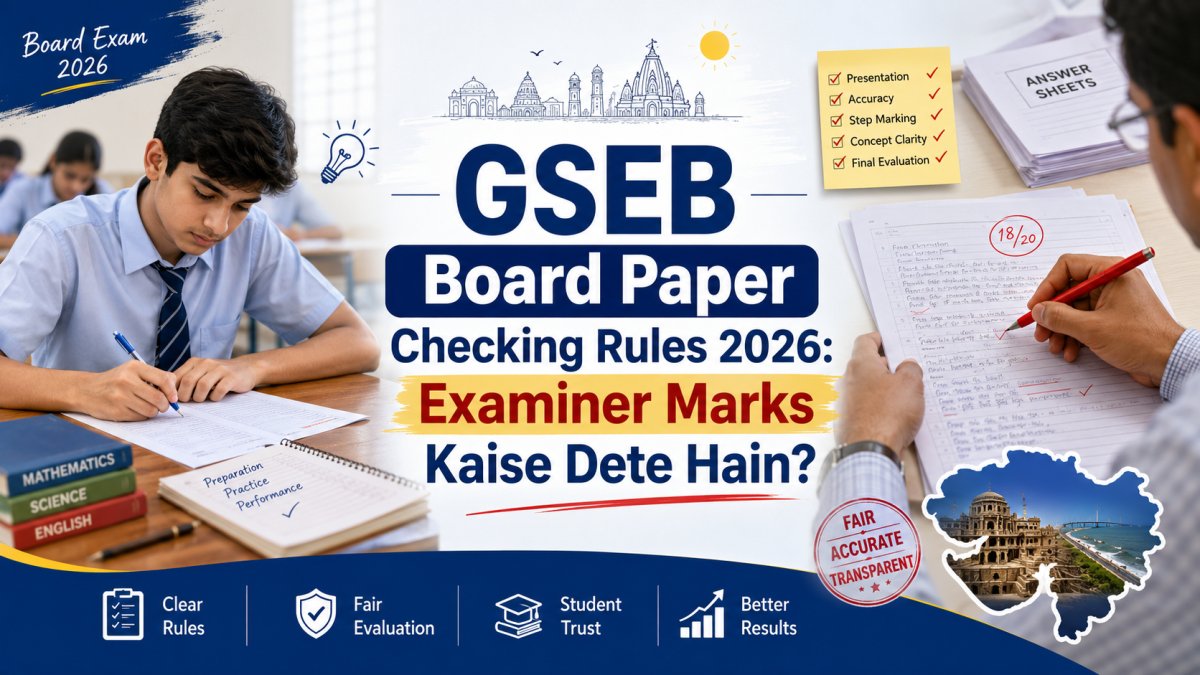
I still remember the strange feeling after finishing my GSEB board papers. The exam was over, but the tension was not. My friends and I kept discussing the same questions again and again.
“Will the examiner understand my answer?”
“I forgot one point. Will I lose all the marks?”
“My handwriting became bad in the last section. What will happen now?”
Almost every board student thinks like this. So, first of all, relax. Examiners are not sitting there to cut your marks without reason. They usually try to find correct points in your answer and award marks according to the marking scheme. Your job is to make those points easy to find.
The New GSEB Pattern Is Better for Students
GSEB has made some positive changes in the board exam pattern. The old rigid system has been replaced with a more flexible General Option pattern.
In my opinion, this is one of the most student-friendly changes made by the board. Earlier, students sometimes had to choose between two questions even when both were difficult. With General Option, students get a better chance to select questions they know properly.
However, freedom of choice does not mean you should attempt the paper randomly.
Complete all compulsory questions first. Do not leave an easy compulsory question just because you noticed an attractive optional question later in the paper. Once the compulsory part is completed, check the remaining time. When enough time is available, attempt the General Option questions too.
This simple strategy can protect your marks and may even improve your final score.
Understand the Sections Before Writing
Every section demands a different style of answer. One of the biggest mistakes students make is writing the same kind of answer for every question.
Here is a simple way to understand it:
| Section | Type of Question | Marks | How to Write |
|---|---|---|---|
| Section A | Objective or Hetulakshi questions | As given | Write the exact answer or correct option |
| Section B | Very short-answer questions | 1 mark | Give one direct and correct point |
| Section C | Short-answer questions | 2 marks | Write two clear points with a brief explanation |
| Section D | Descriptive questions | 3 marks | Write three relevant points in an organised way |
| Section E | Long-answer questions | 5 marks | Add an introduction, main explanation and conclusion |
This structure looks simple, but it can completely change the way your paper is checked.
How Examiners Check Section A and Section B
Section A usually contains objective or Hetulakshi questions. These questions look easy, but students often lose marks because they read them too quickly.
Pay attention to words such as “incorrect,” “not,” “only” and “except.” One small word can change the whole meaning of a question.
In objective questions, avoid unnecessary overwriting. Mark the correct answer clearly. If you change an answer, make sure the final choice is easy to understand.
Section B normally contains one-mark questions. For these questions, the examiner expects one exact fact, definition, name, formula or keyword. There is no need to write a large paragraph for one mark.
I have seen students writing six or seven lines because they are unsure of the answer. That usually does not help. Write less, but write correctly.
The Right Way to Attempt Section C
Section C contains two-mark questions. In most cases, two proper points can help you earn full marks.
Suppose the question asks for two reasons. Write exactly two reasons. Number them clearly. A short explanation after each point makes the answer stronger.
Do not hide the correct answer inside a long paragraph. An examiner checks many answer sheets, so clear presentation matters. When your points are visible, the examiner can quickly understand that you know the answer.
Underlining important keywords can also help, but do not underline every sentence. When everything is underlined, nothing looks important.
How to Score Well in Section D
Section D generally has three-mark questions. These answers need more detail than Section C, but they still do not require a full-page essay.
Start with one direct sentence related to the question. Then write three useful points. Add a brief explanation wherever needed.
For example, if a question asks for three effects, do not write five confusing points. Write three strong and correct effects. Relevant content is always better than random content.
Readable handwriting also becomes important here. Your handwriting does not need to look beautiful. It only needs to be clear enough for the examiner to read without struggling.
Section E: How to Write a Five-Mark Answer
Section E is very important because it contains five-mark questions. These answers usually receive more attention during checking because they carry higher weightage.
A good five-mark answer should have a clear beginning, middle and ending.
Begin with a short introduction. In Gujarati, many students call it “Prastavna.” It should be connected to the topic and should not be longer than two or three lines.
After that, write the main answer using headings or numbered points. Explain each important point properly. Add an example, diagram, map or formula when it is relevant.
Most importantly, do not write random information just to fill the page. Many students call this “gola fekna.” An examiner can easily understand when a student is only trying to make the answer look long. Write fewer points if necessary, but keep them accurate and connected to the question.
End your answer with a short conclusion or “Upsanhar.” A two-line conclusion gives the answer a complete shape. It is especially useful in Social Science, languages and other theory subjects.
Give Enough Time to High-Weightage Questions
Higher-mark questions usually contain several marking points. An examiner may award separate marks for the introduction, correct explanation, important keywords, examples and conclusion.
That is why you should not spend too much time on one-mark questions. Some students write long answers in the beginning and then rush through Section E. This is a serious mistake.
Keep checking the clock. Complete compulsory questions first, give proper time to three-mark and five-mark answers, and then attempt additional General Option questions when time remains.
Trying more questions can help, but only when your compulsory answers are already complete and properly written.
Old Board Papers Can Save You
The best advice I can honestly give is to solve as many old GSEB board papers as possible.
Many questions return in a similar form. Sometimes the wording changes, but the main concept remains the same. Previous papers teach you what the board usually asks, how questions are framed and how much time each section needs.
Do not only read old papers. Sit with a timer and solve them like a real exam. After finishing, compare your answers with the textbook or a trusted solution.
This practice will slowly remove your fear. You will start recognising patterns, remembering important keywords and managing your time better.
Board checking is not something to be scared of. Examiners look for correct ideas, clear presentation and answers written according to the marks. Stay calm, write what you know and make your main points easy to notice.
Your paper does not have to be perfect. It just has to show your preparation honestly and clearly. Trust your hard work. You may score much better than you are expecting.

I am a dedicated person who provides study materials, notes, textbooks, question papers, solutions, and educational updates for all GSEB board classes. My goal is to make learning easier and more accessible for students by sharing useful resources in one place. I believe that every student deserves clear guidance and quality study support to achieve better results. Through my work, I strive to help students learn with confidence and stay updated throughout their academic journey.





Comments (0)