

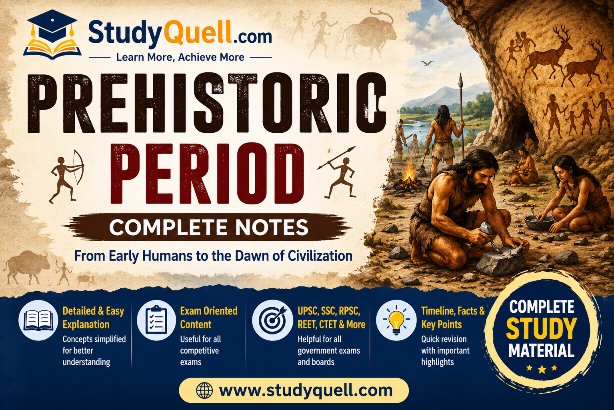
प्रागैतिहासिक काल (Prehistoric Period) Complete Notes
प्रागैतिहासिक काल (Prehistoric Period) complete notes in Hindi & English. Best for UPSC, SSC & PCS.

2. In English Medium
The Prehistoric Period (Stone Age)
Studyquell Premium Exam Notes
In this single comprehensive post, we have meticulously covered every crucial fact regarding the Palaeolithic, Mesolithic, Neolithic, Chalcolithic, and Megalithic periods frequently asked in top-tier competitive exams. An exhaustive master table of important archaeological sites is also included for quick revision.
Classification of History (Flowchart)
(No written evidence available)
(Written records exist, but undeciphered)
(Written & readable sources available)
(2M BC - 12000 BC)
(12000 BC - 10000 BC)
(10000 BC - 3000 BC)
(Stone-Copper Age)
Basic Principles & Sources of History
To understand the gradual evolution of human civilization, history is divided into three major periods. Archaeologist Christian Jürgensen Thomsen divided the entire history into a three-age system (Stone, Bronze, and Iron ages) based on the availability of metals, while John Lubbock classified it based on writing and literary evidence.
EXAM ALERT: Direct Questions Originate Here!
- Father of History: The famous Greek historian Herodotus is considered the Father of History.
- Father of Indian Archaeology: Alexander Cunningham is known as the father of the Archaeological Survey of India (ASI).
- First Discovery in India: In 1863, geologist and archaeologist Robert Bruce Foote discovered India's first Palaeolithic tool (a Handaxe) at a place called Pallavaram near Madras.
- National Museum: The 'Indira Gandhi Rashtriya Manav Sangrahalaya', located in Bhopal (Madhya Pradesh), is India's most unique museum operating under the Ministry of Culture, Government of India.
- Origin of Humanity: The continent of Africa is considered the cradle of humankind, whereas the gradual development of civic civilization took place in the continent of Asia.
1. Palaeolithic Period (Old Stone Age)
Time Period: Roughly 2 Million BC to 12,000 BC
This was the earliest and longest era of human history, corresponding to the Pleistocene Epoch (Ice Age) from a geological perspective. During this time, the earth was largely covered in ice. Humans of this era were completely primitive and barbaric.
Key Lifestyle & Characteristics:
- Food Gatherers & Hunters: Humans of this time were consumers, not producers. They survived solely by hunting wild animals and gathering wild roots and fruits. Their lifestyle was entirely Nomadic.
- Invention of Fire: The most epoch-making event of the Palaeolithic period was the Discovery of Fire, although humans had not yet fully mastered its controlled use.
- Nature of Tools: Tools were made of large, unpolished, and crude stones, primarily crafted from Quartzite, Flint, and Jasper.
Three Sub-Divisions of the Palaeolithic Period:
- A. Lower Palaeolithic: This period mainly utilized Chopper-Chopping and Pebble tools. The Soan River Valley (Soan Culture) in Pakistan and the Belan Valley are prime examples. The oldest bone statue of a Mother Goddess was found in the Belan Valley.
- B. Middle Palaeolithic: Tools began to be made from stone flakes, hence it is also called the 'Flake Culture'. Nevasa in Maharashtra is considered its most prominent center.
- C. Upper Palaeolithic: The climate began to warm up, marking the emergence of Modern Humans (Homo Sapiens). The primary tools were Blades and Burins. Magnificent rock paintings of this era can be seen in the caves of Bhimbetka (Raisen district, MP).
2. Mesolithic Period (Middle Stone Age)
Time Period: 12,000 BC to 10,000 BC
This period was a **Transitional Phase** between the Palaeolithic and Neolithic ages. Significant climatic changes occurred, marking the beginning of the current geological epoch, the Holocene, which led to the melting of ice and the development of grasslands. Information about this period in India was first given by **C.L. Carlleyle** in 1867 after discovering microliths in the Vindhya region.
Key Lifestyle & Characteristics:
- Microliths: Stone tools during this time became very small (ranging from 1 to 5 centimeters). They were crafted to be extremely minute and sharp, hence this era is called the 'Microlithic Age'.
- Beginning of Animal Husbandry: The domestication of animals in human history began during the Mesolithic period. The first animal to be domesticated was the Dog.
- Funeral Rites: The first clear evidence of systematic funeral rites or human burials starts appearing from this period.
- Adamgarh (MP) & Bagor (Rajasthan): The most ancient and authentic evidence of animal husbandry has been obtained from these two sites. Bagor is the largest Mesolithic site in India.
- Sarai Nahar Rai & Mahadaha (UP): Located in the Pratapgarh district, these sites yielded large quantities of human skeletons and pit hearths. Evidence of burying multiple bodies in a single grave was also found here.
- Damdama (UP): Three human skeletons buried together in a single grave were discovered here, which is an extremely important fact from an examination point of view.
3. Neolithic Period (New Stone Age)
Time Period: 10,000 BC to 3,000 BC
The famous historian V. Gordon Childe termed the great changes that occurred during this period as the **'Neolithic Revolution'**. In this era, humans completely transformed from hunters to **'Food Producers'** and began to conquer nature. Evidence of this period in India was first discovered by Le Mesurier in 1860 in the Tons River Valley.
Key Lifestyle & Characteristics:
- Systematic Development of Agriculture: Humans started farming on a large scale. The earliest cultivated crops included Wheat and Barley.
- Settled Social Life: To look after agriculture, humans began to settle in one place, leading to the creation of Permanent Settlements and villages.
- Invention of the Wheel: The invention of the Wheel for carrying heavy loads and making pottery was the greatest technological discovery of this era.
- Polished Tools: Tools of this period were highly smooth, sharp, and polished. Stone axes were predominantly used.
Most Famous Neolithic Sites (Direct Questions):
- Mehrgarh (Balochistan, Pakistan): Located west of the Indus River, it provides the **earliest evidence of agriculture (around 7000 BC)** in human history, where wheat and barley were cultivated. Evidence of settled life and rectangular mud-brick houses was also found here. It is often called the 'Breadbasket of Balochistan'.
- Lahuradewa (Sant Kabir Nagar, UP): According to recent archaeological discoveries, it holds the oldest evidence of rice cultivation between 9000 BC and 7000 BC. This discovery has surpassed even the ancient records of Mehrgarh.
- Coldihwa (Prayagraj, UP): Situated on the banks of the Belan River, this site provides clear evidence of rice (paddy) cultivation dating back to around 6000 BC.
- Burzahom (Srinagar, J&K): The name literally means 'Place of Birch'. People here lived in underground dugouts known as 'Pit-dwellings'. The most unique feature here is the evidence of burying domestic dogs along with their masters' bodies in the graves.
- Gufkral (J&K): Its literal meaning is 'Cave of the Potter'. It yielded numerous tools made of bone, such as needles, along with evidence of agriculture and animal husbandry.
- Chirand (Saran, Bihar): Located north of the Ganges River, this site yielded a massive quantity of Neolithic bone implements and tools, which were primarily made from deer antlers.
4. Chalcolithic Period (Stone-Copper Age)
Towards the end of the Neolithic period, the use of metals alongside stones began. The **first metal discovered and used by humans was 'Copper'**. Due to the combined use of stone (Lithic) and copper (Chalco), this era is called the Chalcolithic Age. It was essentially a **rural farming culture** that later laid the foundation for the urban Bronze Age civilization of the Indus Valley.
Major Regional Chalcolithic Cultures:
Distinct cultures developed in different regions of India during this period, with variations in their pottery and lifestyle:
- Ahar or Banas Culture (Rajasthan): The Ahar site near Udaipur was known in ancient times as 'Tambavati' (Place of Copper) because large-scale copper smelting furnaces and workshops were found here. Its major center was 'Gilund', which showed evidence of baked bricks.
- Malwa Culture (MP): The Malwa culture is famous throughout India for its excellent quality pottery. The most important site of this culture is Navdatoli, excavated by Prof. H.D. Sankalia. The largest variety and heaps of food grains (wheat, linseed, lentils, peas) in India were found here.
- Kayatha Culture (MP): Situated in the Chambal River valley, this culture is considered contemporary to the Harappan civilization. Copper bangles and necklaces of semi-precious stones were found in the houses here.
- Jorwe Culture (Maharashtra): Spread across western Maharashtra, this was the most extensive culture. Major sites include Daimabad, Inamgaon, and Nevasa.
▪️ Daimabad: Solid copper objects like the famous 'Copper Chariot', elephants, rhinos, and buffalo figures were found here.
▪️ Inamgaon: It was the largest fortified settlement of the Chalcolithic period, yielding mother goddess figurines and large granaries.
5. Megalithic Culture
The culture that emerged in South India (Karnataka, Andhra Pradesh, Tamil Nadu, and Kerala) after the decline of the Neolithic period is called the **Megalithic Age**. People of this era used to place huge and massive stone boulders (Megaliths) in circles around the graves of the deceased as identifying monuments. This culture was primarily associated with the use of iron weapons and Black-and-Red Ware (BRW) pottery. Key sites include *Brahmagiri, Maski, and Adichanallur*.
Ultimate Master Table: Key Sites & Vital Evidences
| Historical Period | Major Archaeological Site | Current Geographical Location | Extracted Evidence (Exam VVI) |
|---|---|---|---|
| Palaeolithic Age | Bhimbetka | Raisen District, Madhya Pradesh | The oldest cave paintings (Rock Shell-art) made by early humans; houses over 500 painted rock shelters. |
| Pallavaram | Chennai, Tamil Nadu | Discovery of India's first stone Hand-axe by Robert Bruce Foote. | |
| Hathnora | Narmada Valley, Madhya Pradesh | The very first fossil of a 'Human Skull' (Homo erectus) in India was found here. | |
| Mesolithic Age | Bagor & Adamgarh | Rajasthan & Madhya Pradesh | The most ancient evidence marking the beginning of Animal Domestication in human history. |
| Mahadaha & Sarai Nahar Rai | Pratapgarh, Uttar Pradesh | Bone ornaments, pit hearths, and primary remains of human skeletons. | |
| Neolithic Age | Mehrgarh | Balochistan, Pakistan | Oldest evidence of agriculture (wheat and barley), permanent settlements, and mud-brick houses. |
| Burzahom | Srinagar, Jammu & Kashmir | Pit-dwellings (underground dugouts) and the unique practice of burying dogs with their human masters. | |
| Coldihwa | Prayagraj, Uttar Pradesh | The earliest and most ancient evidence of Rice (Paddy) cultivation in the world (6000 BC). | |
| Chirand | Saran, Bihar | Abundant quantity of bone tools and weapons crafted specifically from deer antlers. | |
| Chalcolithic Age | Navdatoli | Banks of Narmada, Madhya Pradesh | The most extensively excavated Chalcolithic site, yielding a huge variety of food grains in large deposits. |
| Daimabad | Ahmednagar, Maharashtra | Heavy solid copper items were found, the most famous being the 'Heavy Copper Chariot'. | |
| Inamgaon | Pune, Maharashtra | The largest fortified and moat-surrounded rural settlement of the Chalcolithic era; mother goddess figurine found. |
Studyquell Note to Students: The Prehistoric Age forms the foundation of human evolution. Memorizing the facts provided in this article will effectively prepare you for this topic. All the best for your exams!
What's Your Reaction?
 Like
1
Like
1
 Dislike
0
Dislike
0
 Love
0
Love
0
 Funny
0
Funny
0
 Wow
0
Wow
0
 Sad
0
Sad
0
 Angry
0
Angry
0






Comments (0)